
Capgemini's AI services are actually there
In our previous teaser (07/10/2025), we painted a picture that was becoming increasingly untenable for Capgemini (ADD, France), going so far as to label the stock a value trap. Events proved us right: the shares subsequently plummeted 31% before initiating a sharp rebound following H1 2026 results. Beyond financial performance, the group unveiled a strategic roadmap at its May CMD built on a core conviction: the enterprise-scale adoption of agentic AI is inextricably linked to resolving technical debt, positioning the IT integrator as the indispensable architect of this transition. We fully subscribe to this investment thesis, even as the group currently finds itself navigating between two worlds.

Build for the old world…
Capgemini closed 2025 with over 400,000 employees and €22.5bn in revenue, a snapshot that perfectly embodies the legacy IT services model anchored in offshore labour arbitrage. The group operates across two deeply mismatched geographic maps: APAC carries nearly two-thirds of the headcount (primarily in India ~94%), while Europe holds a quarter and North America just 5%. Revenue runs strictly in reverse, with North America generating 28% and Europe 62%, leaving APAC to contribute under a tenth despite housing two out of three employees. This remains the group's operational reality today as it enters the agentic era.
CAPGEMINI'S Geographical Breakdown (2025)
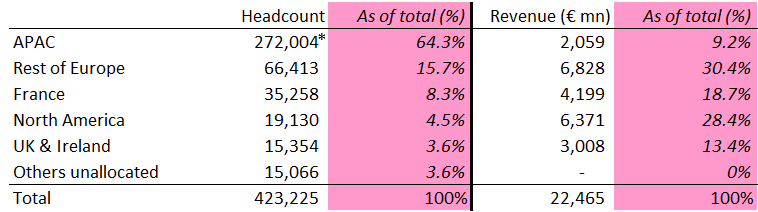
*India is estimated to account for roughly 94% of APAC headcount, representing c. 256k people.
Built over two decades of labour arbitrage, this delivery architecture was optimised to bill hours and scale headcount. Today, it defines the group's "old world" operational reality. The central question raised by the CMD strategy is whether an industrial machine engineered for volume can successfully transition to monetising outcome-based AI solutions rather than selling billable hours.
… Too old a model
WNS is not just about headcount; it is also about value
Build for the old world…
Capgemini closed 2025 with over 400,000 employees and €22.5bn in revenue, a snapshot that perfectly embodies the legacy IT services model anchored in offshore labour arbitrage. The group operates across two deeply mismatched geographic maps: APAC carries nearly two-thirds of the headcount (primarily in India ~94%), while Europe holds a quarter and North America just 5%. Revenue runs strictly in reverse, with North America generating 28% and Europe 62%, leaving APAC to contribute under a tenth despite housing two out of three employees. This remains the group's operational reality today as it enters the agentic era.
CAPGEMINI'S Geographical Breakdown (2025)
*India is estimated to account for roughly 94% of APAC headcount, representing c. 256k people.
Built over two decades of labour arbitrage, this delivery architecture was optimised to bill hours and scale headcount. Today, it defines the group's "old world" operational reality. The central question raised by the CMD strategy is whether an industrial machine engineered for volume can successfully transition to monetising outcome-based AI solutions rather than selling billable hours.
… Too old a model
Through the acquisition of WNS and rapid headcount growth, Capgemini appears perfectly equipped to tackle the old world. The group hires young talent offshore, bills clients in mature markets, and charges by the hour: both revenue and costs scale directly with headcount, and margin is simply the spread between an hour worked in Bangalore and an hour billed in Chicago. Powered by a youthful, constantly replenished pyramid, this model delivered stable operating margins for two decades. Yet it hinges on one critical premise: that billable hours can be sold at steadily increasing prices.
That old world has been unravelling since the start of the decade. Between 2020 and 2024, cost per employee grew at a compound rate roughly twice as fast as revenue per employee, pushing personnel expenses from 66% to over 68% of revenue each year. Wage inflation not passed on largely accounts for the flat operating margin observed since 2023. While natural turnover helps reset base costs in Asia-Pacific, it fails to do so in France, where low attrition creates a persistent margin bottleneck, as management acknowledges. As a result, restructuring charges are ramping up again in the second half, booked below the operating margin line.
CAPGEMINI's Revenue/Employee vs. Cost/Employee (2020-2025, in k€)

CAPGEMINI's Revenue/Employee vs. Cost/Employee (2020-2025, in k€)
WNS is not just about headcount; it is also about value
At first glance, acquiring such a massive workforce in BPO, a segment highly vulnerable to disruption by agentic AI and vibe coding, may seem paradoxical. However, Capgemini sought a targeted technological and operational capability in WNS, namely Intelligent Business Operations. WNS anticipated the sector shift toward Business Process as a Service (BPaaS), where agentic AI absorbs volumetric work and accountability relies on outcomes achieved rather than hours billed.
In this new configuration, the renewable low-cost offshore pyramid will no longer be rebuilt in its original form. Instead, a genuine white-collar robotics setup, composed of AI agents framed by strict governance rules essential in a non-deterministic environment, now handles the raw workload.
Here lies the true pivot of the transaction: enabling Capgemini to immediately acquire the operational capacity to run an outcome-based pricing model. Transitioning from a Time & Materials model to performance-based pricing requires flawless execution risk management, advanced contractual governance, and precise modelling of the financial return for the client. Developing these capabilities organically would have taken years. By integrating WNS, Capgemini secures a strategic shortcut to combine deep business process knowledge with outcome-oriented pricing mechanisms.
In a world where AI commoditises core IT skills, this ability to directly monetise created value serves as the indispensable bridge between the traditional IT services model and the new paradigm of the agentic era.
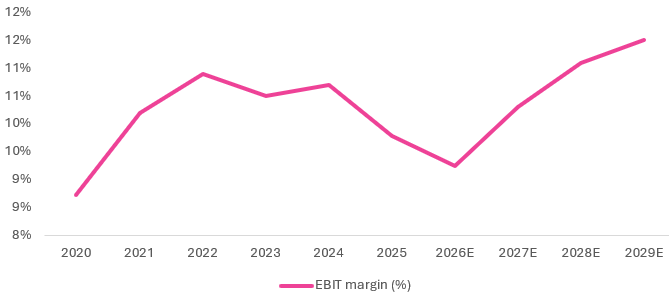
CAPGEMINI'S EBIT margin (%) 2020-2029E
Entering a new paradigm
CAPGEMINI'S EBIT margin (%) 2020-2029E
Entering a new paradigm
With the WNS acquisition, Capgemini has actively repositioned itself to counter smaller, more agile IT providers who were earlier adopters of flexible and predictable pricing models. While legitimate questions remain over how such a massive headcount will fare in a market anticipating structural price deflation, this is precisely where the strategic rationale for the Fit-for-Growth plan lies. Restructuring will inevitably weigh on financial performance through 2026, with residual charges lingering into 2027, but it provides the essential framework to absorb this transition
Ultimately, the French IT powerhouse is turning the page on two decades of volume-driven, low-cost offshore labour arbitrage. The focus is pivoting toward deploying high-margin, auditable, and dependable enterprise-grade AI solutions at scale. This structural transformation underpins our positive thesis and supports our bullish stance, offering a 25% upside potential.

Subscribe to our blog

Ferrari beats both its parent Exor and fellow scarcity play Hermès: cheaper valuations elsewh...


Over ten years, UK corporates beat their French peers on 7 of 13 paired comparisons in euros - and ...