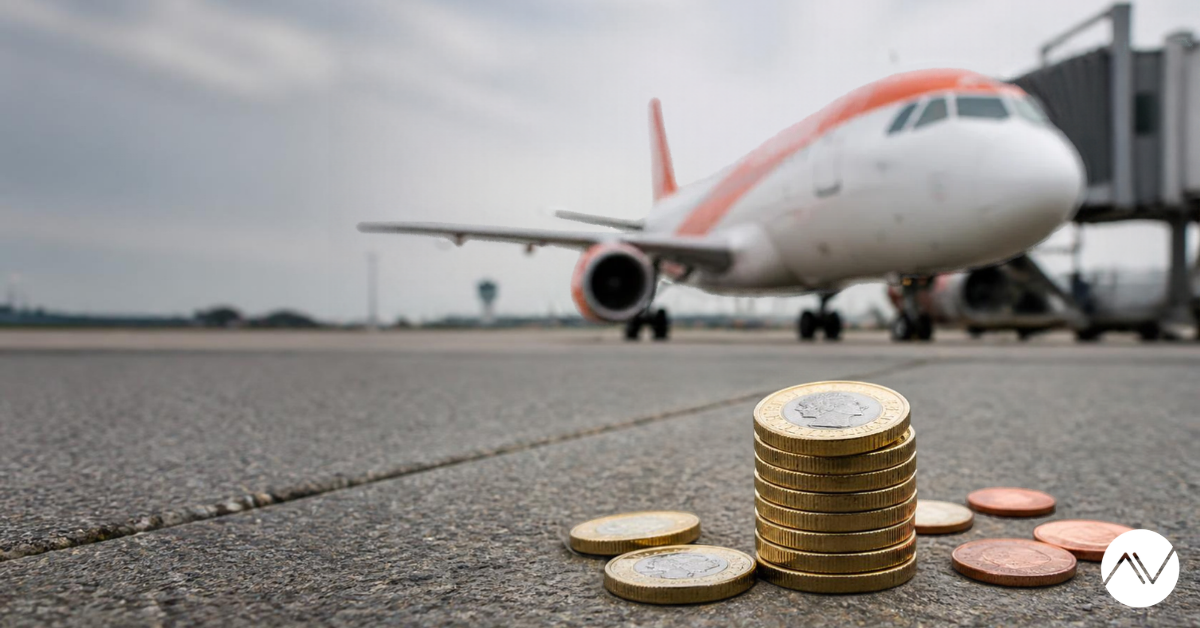
easyJet is not for sale
Since our last teaser ("easyJet (ADD; UK) Holidays' Looks To Be The Right Move"), in which we put our finger on the market's undervaluation of easyJet's shift towards a hybrid airline–tour operator model, someone with a cheque book has reached the same conclusion – Apollo's 715p offer, our valuation back then sat at 689p. We recommend holders to keep their shares after revising our target price to 853p.
Apollo walked in and made off with the loot
In this saga, Castlelake did the hard work. The fund opened bids at 560p on 12 June and was rebuffed. It came back, was rebuffed again, got access to the books on 25 June and finally won the board over on its fifth attempt, at 690p in early July. That valued easyJet at c.£5.5bn fully diluted. The agreement in principle lasted less than a week. On 10 July Apollo turned up with 715p, a modest 3.6% more. Castlelake spent four weeks considering its options and concluded on 6 August that it had none. The same day, Apollo published its firm Rule 2.7 offer.
Apollo has been around airlines for a decade. Its aviation book reads less like an airline portfolio than a lender's ledger. It lent $1bn to Aeroméxico in Chapter 11 in 2020 and $700m to SAS in 2022 on super-senior terms; the equity went to Castlelake, and the two have a habit of meeting at airlines. It financed Air France's spare engines (€500m, 2022), its spare parts (€500m, 2023), and finally its frequent-flyer miles (€1.5bn, 2023). Each time the money went through perpetual bonds issued by a ring-fenced affiliate, booked as equity by Air France-KLM (France, Sell) and paying Apollo 6% on the engines and 6.4% on the miles. Add a stake in Sumisho Air Lease (formerly Air Lease, $28bn of EV, closed in April alongside Sumitomo, SMBC and Brookfield), and an aircraft lending platform bought from GE in 2019, and Apollo has a seat at almost every layer of the aviation capital. In the buyout category, the examples of Sun Country (acquired in 2017, partially sold to Amazon as a cargo operator, taken public, and ultimately absorbed by Allegiant this past May) and Atlas Air (taken private in 2023 with management kept in place) add weight to the argument, even though the question of legal structure does not apply to these strictly domestic US transactions.
Cheap valuation
Like any European business that American giants are taking over, it's happening at a bargain price. At 715p, the headline premium is 81% to the undisturbed price of 394p, but the small print is worth a read. Strip out the fuel shock and the premium falls to 54% against the last close before the Middle East conflict (464p, 27 February). Set it against the best price easyJet reached on its own over four years (588p, June 2025), and it shrinks to 22%.
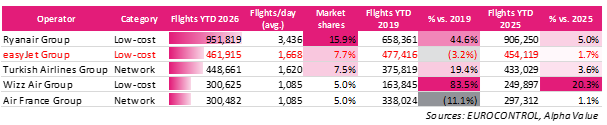
In our view, the airline seems like an exceptional deal for Apollo, which is benefitting from a weakened and undervalued sector with regard to its assets. Here we talk about an all-Airbus fleet with a filled order book and highly sought-after slots. On FY25 basis - the best year in the airline's history with £1.45bn of EBITDA - 715p values the group at 3.6x EV/EBITDA and 10.9x earnings. That is twice what the market was paying at the undisturbed price (1.8x), and still roughly a third below the c.5x the stock has averaged since 2019. EV/Sales is the one multiple the fuel shock does not distort, and it reflects a c.0.5x revenue in both FY25 and FY26, above the 0.33-0.39x easyJet traded at over FY23-25 - yet still well short of the c.1.3x Ryanair (Ireland, Add) commands. Always remember, easyJet has yet to reach its pre-2019 level, but remains the 2nd carrier in number of flights with 7.7% market share.
EZJ ended June with £3.6bn in cash and £661m in net cash, while its owned aircraft are carried at around £5bn. Apollo is therefore paying £5.7bn of equity for a business whose owned fleet alone is worth almost as much. This apparent valuation support is further reinforced by easyJet’s 287 firm Airbus orders, particularly valuable in a market where narrowbody delivery slots are effectively sold out until the end of the decade, with IBA estimating the order book’s delivery value at around $18bn.
Beyond the fleet and order book, easyJet also controls a portfolio of scarce airport slots, which do not appear on the balance sheet, but represent significant strategic and financial value. IBA estimates a single Gatwick slot pair could be worth up to $9m, while easyJet holds 196 such pairs. Importantly, these slots can also potentially be used as collateral for financing: in November 2025, Apollo itself lent Virgin Atlantic $745m secured against its Heathrow slots. This gives Apollo a clear understanding of how to monetise the financing value of these scarce assets. At the same time, the company faces substantial near-term fleet investment, with around 90 aircraft deliveries over FY26-28, and capex expected to reach £1.7bn in FY26, £2.3bn in FY27 and £3.3bn in FY28.

The board judges the cash terms fair and reasonable and recommends them unanimously.
Regulations' hotspot
For now, the shares trade in a 675-680p range, a 4.9-5.6% discount to the offer. The market is not doubting Apollo's, it is doubting Brussels. The reason sits in the structure. Eagle Bidco, a Jersey company, acquires 100% of easyJet through a scheme of arrangement; above it sit three intermediate Midcos and a Jersey Topco. Topco's ordinary equity is split three ways:
• the Apollo funds, capped at 49.9%;
• shareholders who roll their easyJet shares into Topco one-for-one instead of taking 715p, with 45.1-49.9%;
• an EU trust holding up to 5% for management incentives.
This is where Sir Stelios Haji-Ioannou comes back in and helps secure the deal. His family has irrevocably undertaken to roll its 116m shares (15.3%). The founder, a Cypriot and therefore an EU national, is the European half of the deal.
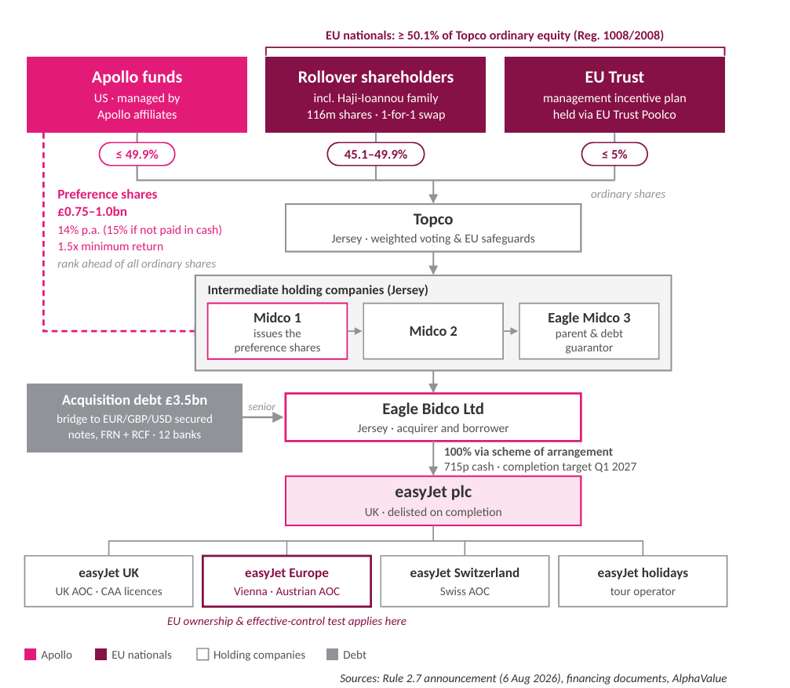
The undertakings that matter, though, are the ones Brussels will read. Under Regulation 1008/2008, easyJet Europe's Austrian licence requires the airline to be more than 50% owned and effectively controlled by EU nationals. Apollo’s Topco documents show how that requirement is being translated into the ownership and governance structure of the deal, while at the same time giving the Apollo funds substantial control over the vehicle. The Apollo funds receive:
• control of the exit, since no sale or IPO can happen without their consent;
• a broad power of attorney over rollover shareholders' votes;
• an exemption from the compulsory transfer provisions aimed at non-EU holders.
While shareholders can roll over to the new business, this is not what we advise as 1) rollover holders below 20% get no board seat and no information rights and 2) private investors will be locked into owning their stake for at least three years. The same documents also allow weighted voting in favour of EU nationals and the removal of non-EU directors if needed (easyJet has used this toolkit since Brexit, when it capped non-EU ownership at 49.5% and suspended voting rights on a "last in, first out" basis). The scheme document was pushed back to 15 October. Shareholder meetings follow in the week of 9 November, and completion is still Q1 2027.
Our take: transaction will proceed on more stringent terms regarding who steers
The transaction will likely go through, but the closing may take longer given the complexity of the transaction. Let’s wave off the news stating that the EU was preparing an autumn review of ownership and control rules to "protect strategic autonomy” - any large overhaul in EU review will probably take years. But we doubt Brussels will leave the structure untouched. Indeed, the deal is like opening Pandora’s box for American funds luring for cheap European airlines. The most likely outcome is clearance with strings attached: an EU-majority board at Topco and easyJet Europe with an EU chair holding the casting vote, Apollo's reserved matters trimmed back to minority protections, and the power of attorney over rollover votes gone. Tougher fixes are possible, from an EU veto over the exit to an IAG-style nationality structure, or a larger EU equity buffer that would dilute Apollo's returns. None of these touches the 715p. What Brussels can take away is Apollo's comfort, not the shareholders' cash.
Nonetheless, no shareholder should rubber-stamp 715p. In the first rounds, the board's repeated rebuffs of Castlelake read like pride as it squeezed 155p out of a reluctant bidder. But the final act was a buzzkill, Apollo topped Castlelake by a mere 3.6%, and Castlelake walked away without any counter-bid: not even a glimmer of a bidding war. 715p looks less like the price of easyJet than the price of ending the auction.
The case for holding is the following.
First, the assets. At c.£5.1bn of EV, Apollo is essentially paying for the owned fleet; everything else comes for free, starting with slots that money cannot buy in Europe; only remedies can. Second, the order book: 287 firm Airbus orders and 100 purchase rights, worth c.$18bn at delivery, in a market sold out until the end of the decade. Hence the plan reported by Bloomberg: pledge today's fleet to fund the buyout, and sell-and-lease-back tomorrow's deliveries for cash. Third, the brand and the team behind it: a 46% rise in headline PBT over FY23-25, a holidays business that hit its £250m target a year early, and a loyalty scheme due next year to monetise 100 million customers.
Let's do the maths: easyJet flies roughly half as many flights as Ryanair, yet Apollo is valuing it at barely a quarter of Ryanair's enterprise value. Margins explain part of the gap (Ryanair converts c.15% of revenue into profit, easyJet half that), but only part. Ryanair trades at c.1.4x sales; apply half that multiple to easyJet, in line with half the margin, and the airline is worth c.0.65x sales, or c.940p a share, 30% above the offer. That is before giving any credit to a path towards 115 million passengers and >£1bn of pre-tax profit by 2030, a target that looks modest next to Ryanair's 300 million by FY34 or Wizz Air's ambition to nearly double revenue by FY30 from a 2.5% margin.
Keep your easyJet shares.

Subscribe to our blog
Ferrari's modest 2030 targets mark a return to its scarcity-led roots, with pricing, mix and perso...

If Canada becomes an EU "Associate Member", the main winners would be European inf...