Ferrari: The Luxury Of Scarcity
Since our last teaser on Ferrari (ADD; Italy) in June 2024, the group reached an all-time high of €480 in 2025, before declining 45% as the market digested 2030 objectives that fell short of (high) expectations. Since then, Ferrari has undergone a significant product changeover, including the introduction of its F80 supercar and the launch of the divisive BEV Luce, its first fully electric car. We have maintained a positive view on the group since its Capital Markets Day, viewing the stock as a strong buy-and-hold opportunity, supported by Ferrari's unique business model, strong fundamentals and limited downside risk.
2030 target solidified the group’s scarcity-based business model
Ferrari's 2030 targets imply a significant slowdown compared with its track record between 2018 and 2025, raising concerns over a potential shift in the group's equity story. The targets imply a sales CAGR of around 5%, significantly below the 13.5% CAGR achieved between 2021 and 2025, alongside limited margin expansion and an EPS CAGR of around 6%, compared with 18% annual EPS growth over the same 2021-2025. From our perspective, however, we expect around 10% annual EPS growth through 2030.
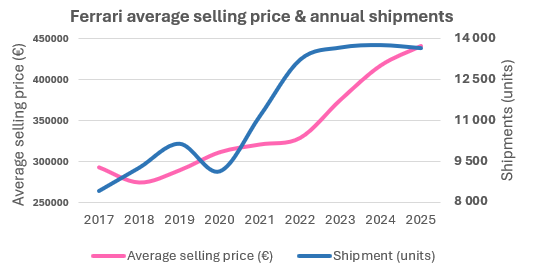
These targets were not a cause for concern for us and, in fact, reinforced our positive view on the group. Firstly, Ferrari has a strong track record of outperforming its targets, with consistent guidance upgrades and its 2026 targets reached a year ahead of schedule. We therefore view the 2030 targets as a floor rather than a ceiling for Ferrari, in line with management's strategy of controlled growth and achievable objectives. Secondly, following a near doubling in annual shipments to around 14,000 units between 2018 and 2026, the targeted 1% volume CAGR represents a return to its scarcity-led roots.
We believe the strategy is to increase the number of models while reducing units per model, allowing Ferrari to broaden its product offering without materially increasing volumes. This should help preserve exclusivity, support residual values and protect the brand's positioning, while allowing revenue and earnings growth to increasingly come from product mix, personalisation and higher-value models rather than unit growth.
Price and mix to fully offset limited volume growth
We expect Ferrari to remain below 15,000 annual shipments despite higher potential manufacturing capacity. With volumes intentionally limited, Ferrari's key earnings growth drivers are mix, pricing and personalisation, three words to describe the same reality of ever higher prices.
Ferrari continues to improve its mix by introducing higher-priced models such as the F80 supercar, with a base price of €3.5m, replacing the Daytona SP3, initially priced at around €2m. The steady improvement in mix is evident in the increase in Ferrari's average selling price, from €270k in 2017 to roughly €480k in 2026. With around 20 model launches expected before 2031, we are confident that mix will remain a strong growth driver, with the 799 F80 units alone providing a significant contribution to mix.
Personalisation is also crucial to Ferrari's equity story, with 100% of Ferraris sold with personalisation. It now represents around 20% of Automotive revenues and is highly margin-accretive, providing an additional avenue for earnings growth without increasing volumes. In addition, Ferrari's unrivalled brand image and customer loyalty underpin extremely strong pricing power. The group consistently raises prices across both vehicles and personalisation by around 5-7% annually, more than offsetting cost inflation and supporting continued margin expansion.
Luce: when breaking tradition makes sense
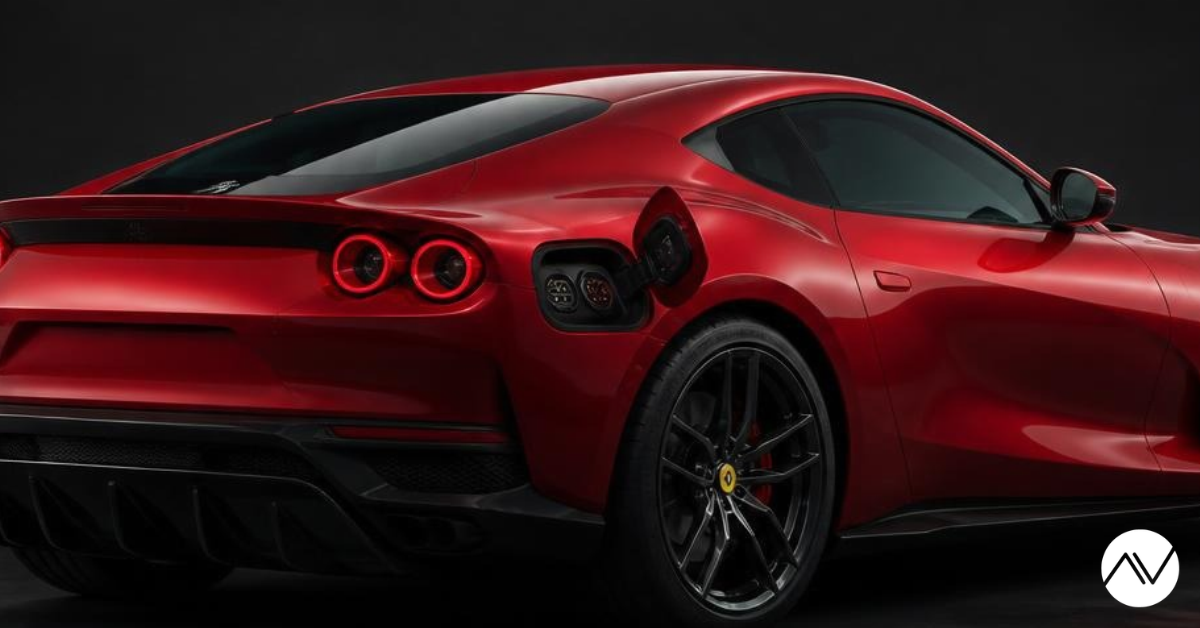
The launch of the BEV Luce was highly divisive, with its design breaking significantly from the traditional styling of the Prancing Horse. We believe the first BEV launched by a luxury high-performance vehicle manufacturer had to differentiate itself meaningfully from its ICE heritage.
Firstly, while the design of an ICE Ferrari is primarily focused on maximising downforce, the design of an EV places greater emphasis on aerodynamics, as the placement and weight of the battery significantly alter the vehicle's weight distribution and dynamics. Secondly, we believe that simply combining Ferrari's traditional design with an electric powertrain could have risked diluting the brand image, given the absence of the iconic Ferrari engine sound. Instead, the Luce's unique 5-seat design allows Ferrari to create a new type of Ferrarista, with BEV enthusiasts and families representing potential new customer groups. This is particularly relevant given the growing population of ultra-high-net-worth individuals, expected to increase by around 40% by 2030, as well as the strong popularity of the Purosangue, the closest thing to a Ferrari family car. We therefore see the Luce as an opportunity to expand Ferrari's target market and product portfolio without diluting the ICE part of the portfolio. At least for the next few years.
We are confident that Ferrari will sell a reasonable number of these vehicles despite its high price tag of around €550k, which reflects the group's unparalleled brand image. With around 70% of current shipments going to existing Ferrari owners, we believe collectors will represent only a small share of demand, with this being offset by the new customer base targeted by the Luce.
Ferrari has become Exor's largest asset
In our SOTP of Exor (BUY; Netherlands), Ferrari represents around 40% of the holding's asset value, making it by far the group's most important asset. This has become increasingly pronounced as the value of Exor's other major holdings has declined, particularly Stellantis, whose share price has fallen c.85% and whose dividend has been suspended, and CNH, which continues to struggle amid the current agricultural downcycle. Exor sold a 4% stake in Ferrari in February 2025. While the sale did not reflect any concern over Ferrari's underlying business, it could create downside risk if John Elkann, head of Exor, were to sell further shares.
In March 2026, Iveco sold its defence business to Leonardo and paid an extraordinary dividend, with the remaining business now being sold to Tata Motors. Excluding internal cash from Lingotto, Exor's asset manager, the holding's recurring dividend base now relies mainly on Ferrari and Philips. However, Ferrari's low dividend yield means Exor's c.€13bn stake generates only c.€137m a year, whereas the February 2025 sale of a 4% stake alone raised c.€3bn, making a stake sale a far quicker way for Exor to raise cash than relying on dividends. We nonetheless find a further sale unlikely, limiting the overhang risk. Ferrari is Exor's most valuable asset and the core of the family holding, while Exor stated at the time of the 2025 sale that it intends to remain Ferrari's reference shareholder.
Ferrari trading at a discount
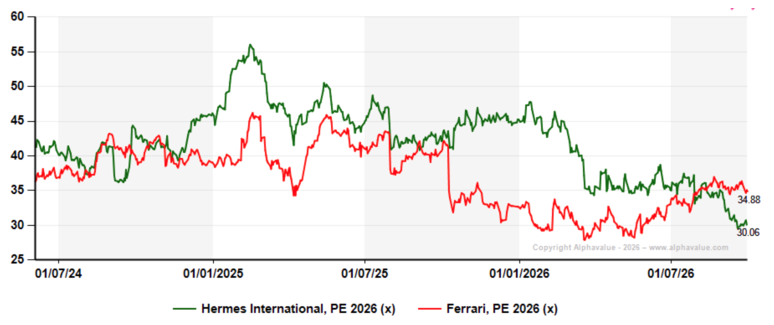
Given its luxury profile and strong earnings growth, Ferrari has historically traded at a high P/E multiple of between 30x and 45x. Currently trading at around 35x, the stock remains towards the lower end of its historical range, leaving room for a rerating towards 45x and implying significant upside potential. Interestingly, Ferrari is currently trading at only a small premium to Hermès, a relatively rare occurrence despite the companies' similar scarcity-based business models, margin profiles and comparable EPS growth.
Unlike Hermès, whose demand is more exposed to developments in China, Ferrari's scarcity-based business model, strong pricing power and exceptional earnings visibility provide greater resilience to changes in the macroeconomic environment. In our view, Ferrari's current valuation does not fully reflect these characteristics, leaving room for a rerating towards the upper end of its historical valuation range.
Valuation
Our 25% upside is mainly driven by our DCF valuation, reflecting Ferrari's significant FCF generation and continued margin expansion above 30%. With the shares currently trading below their historical trading range, we believe the stock offers an attractive entry point.
We reiterate our Buy view on Ferrari, supported by its unique scarcity-based business model, record order book covering all of 2027 and sustained pricing power. These characteristics provide exceptional earnings visibility and resilience to macroeconomic, tariff and FX headwinds. The latest guidance upgrade, combined with personalisation revenues ahead of plan, provides further evidence of Ferrari's long-standing track record of exceeding guidance and achieving strategic targets ahead of schedule. This supports our view that the group's 2030 financial targets represent a floor rather than a ceiling, while leaving room for further upside as Ferrari continues to deliver on its strategy.

Subscribe to our blog

If Canada becomes an EU "Associate Member", the main winners would be European inf...

Ferrari beats both its parent Exor and fellow scarcity play Hermès: cheaper valuations elsewh...