
Sanofi's new leadership needs to move mountains
Imagine a restaurant having to serve its customers by ordering outside food. We cannot resist drawing parallels between this hypothetical scenario and what Sanofi (BUY; France) has been going through for years now. Despite being in the business of innovative medicines, some of its key drugs have come through partnerships and/or acquisitions, and not by internal capability – Dupixent (immunology; partnered with Regeneron; c.36% of sales), Altuviiio (haemophilia; through Bioverativ acquisition in 2018; c.3%), and Beyfortus (infant RSV (respiratory syncytial virus) vaccine; partnered with AstraZeneca; c.4%), to name a few.
The internal R&D show over the last three-to-four years has frustrated the management, the board and the shareholders alike. Late-stage setbacks have stung Sanofi in respiratory, neuroscience, oncology and immunology areas. While we deliberately avoid mentioning crackjaw-named drug failures, even the proclaimed positive readout of immunology drug candidate Amlitelimab (projected as one of the key successors to Dupixent) elicited negative market response in late-2025, and recently the management decided to not invest further in the drug’s eczema indication (was its major potential sales driver).
The share price performance doesn’t hide anything – no wealth creation (except dividends) over the last four years.
Shareholders’ agony
Shareholders’ agony
A ship with no steady captain
Owing to the board’s frustration and impatience, for at least the last two decades, Sanofi has struggled to find a long-tenure CEO, who could steer the firm through the industry’s challenges – loss of exclusivity, competitive pressures, R&D setbacks and chasing right therapeutic areas, among others. In 2014, the erstwhile CEO of six years, Chris Viehbacher, was sacked abruptly. Then his successor Olivier Brandicourt’s tenure was also short (2015-19), as he was made to retire (perhaps) because of Sanofi’s internal rule that prevented the CEO serving beyond the age of 65. Wow(!), this appears astonishingly hypocritical considering the 2026 appointment of Ms. Belén Garijo (already aged 66) as the CEO. Back in 2019, when Paul Hudson was given the top job, he had two broad mandates: 1/ turning Sanofi into a more innovative company and reduce external reliance; and 2/ finding successor(s) to Dupixent. After over six years in this job and multiple R&D setbacks, Hudson admitted that he had underestimated his challenges, and eventually he was let go earlier this year.
Hudson’s unfulfilled mandate is still Sanofi’s top priority. Even the choice of the current CEO reflects a firefighting approach rather than a long-term vision from the board, considering Ms. Garijo’s age.
From our vantage point, the cure may essentially lie in overhauling the internal R&D structure and processes, which may not please shareholders with a myopic view, as it could take five-to-seven years for the efforts to translate into results. In this regard, Mr. Paulo Fontoura’s recent appointment as the R&D head offers a ray of hope. He comes with >25 years of experience, with nearly 15 years of it spent at Roche – known for having strong internal R&D capabilities – developing new molecular entities spanning various therapeutic areas.
The path ahead is steep, though not insurmountable
Despite all the above-mentioned challenges, there is a silver lining that Dupixent still has nearly five more years of patent-protected life. While Dupixent garnered c.€16bn sales in 2025, it could generate €22-25bn topline at its peak. Plus, we foresee no other major patent expiration in the next five years. Rare disease drugs like Altuviiio and Ayvakit (for types of cancer in the digestive tract and bone marrow) have multi-blockbuster potential and can contribute meaningfully to Sanofi’s growth. Moreover, the defensibility of vaccines franchise (c.18% of sales) is often underestimated, since vaccines are very complicated biologics, and making a true replica of a vaccine by another firm is extremely hard. This is why Sanofi, one of the ‘big four’ vaccine players, may face competition from newer vaccines, but not any ‘biosimilar’ of its vaccines. While the presence of Robert F. Kennedy Jr. as the head of the US health department might remain an overhang for vaccine players, the long-term stability of this franchise should not be in contention.
Importantly, Dupixent’s phenomenal rise since its approval in 2017 has provided resilience to the topline (mid-single digit CAGR of pharma + vaccines business over 2017-25) and operating margins, which have broadly hovered around 20-22%. We expect similar profitability resilience with mid-single digit topline CAGR in the medium-term. Nonetheless, note that Sanofi’s operating profitability falls at the lower end of the AV Big Pharma range. This is because it has to share, with its partners, profits from some of the high-flying drugs.
Overall, along with the above-mentioned elements, nearly €7bn p.a. pre-dividend FCFs expected over 2026-28 (somewhat lower than last seven years’ average) and a healthy balance sheet (2026e net debt-to-EBITDA of 1.7x) offer Sanofi with the option to chase external innovation and continue investing meaningfully into its own R&D (c.18% of sales, now in line with AV Big Pharma average). The 48% stake retained in consumer healthcare business Opella, further adds to the fire power (c. €15bn).
That said, the risks to the current operating momentum lie in competitive threats to Dupixent from the likes of GSK’s (ADD; UK) Exdensur, Beyfortus, and from US-based Merck’s Enflonsia.
Valuation apparently cheap, with a reason
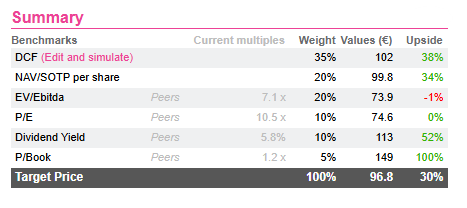
The 2026e P/E of c.12x (vs. c.18x average over the last 10 years and c.17x AV Big Pharma average) and a c.6% dividend yield (assured by three decades of increasing dividends) might seem like an attractive proposition. However, we opine that investors might be better off looking at other options. This is because we do not see a meaningful catalyst in the near-term and the upside could be realised only after the markets see a hope of decent life beyond Dupixent’s patent-protected years, and a turnaround of internal R&D capabilities. The task is easier said than done, and the new management may have to pull out all the stops.
Valuation apparently cheap, with a reason
The 2026e P/E of c.12x (vs. c.18x average over the last 10 years and c.17x AV Big Pharma average) and a c.6% dividend yield (assured by three decades of increasing dividends) might seem like an attractive proposition. However, we opine that investors might be better off looking at other options. This is because we do not see a meaningful catalyst in the near-term and the upside could be realised only after the markets see a hope of decent life beyond Dupixent’s patent-protected years, and a turnaround of internal R&D capabilities. The task is easier said than done, and the new management may have to pull out all the stops.
Subscribe to our blog


Ferrari's modest 2030 targets mark a return to its scarcity-led roots, with pricing, mix and perso...

If Canada becomes an EU "Associate Member", the main winners would be European inf...